Siemens Smart Infrastructure has unveiled SIPROTEC V — a virtualized version of the SIPROTEC 5 platform for protection and control tasks in digital substations. According to Siemens, the solution consolidates the functionality of up to 60 hardware SIPROTEC 5 devices in a single server-based solution.
The core idea of SIPROTEC V is to decouple protection and control functions from a dedicated hardware device and to move them into a server software environment. Siemens describes this approach as software-defined protection and control: the protection algorithms remain the same as in SIPROTEC 5 devices, but they no longer run in separate physical terminals — they run on a server platform.
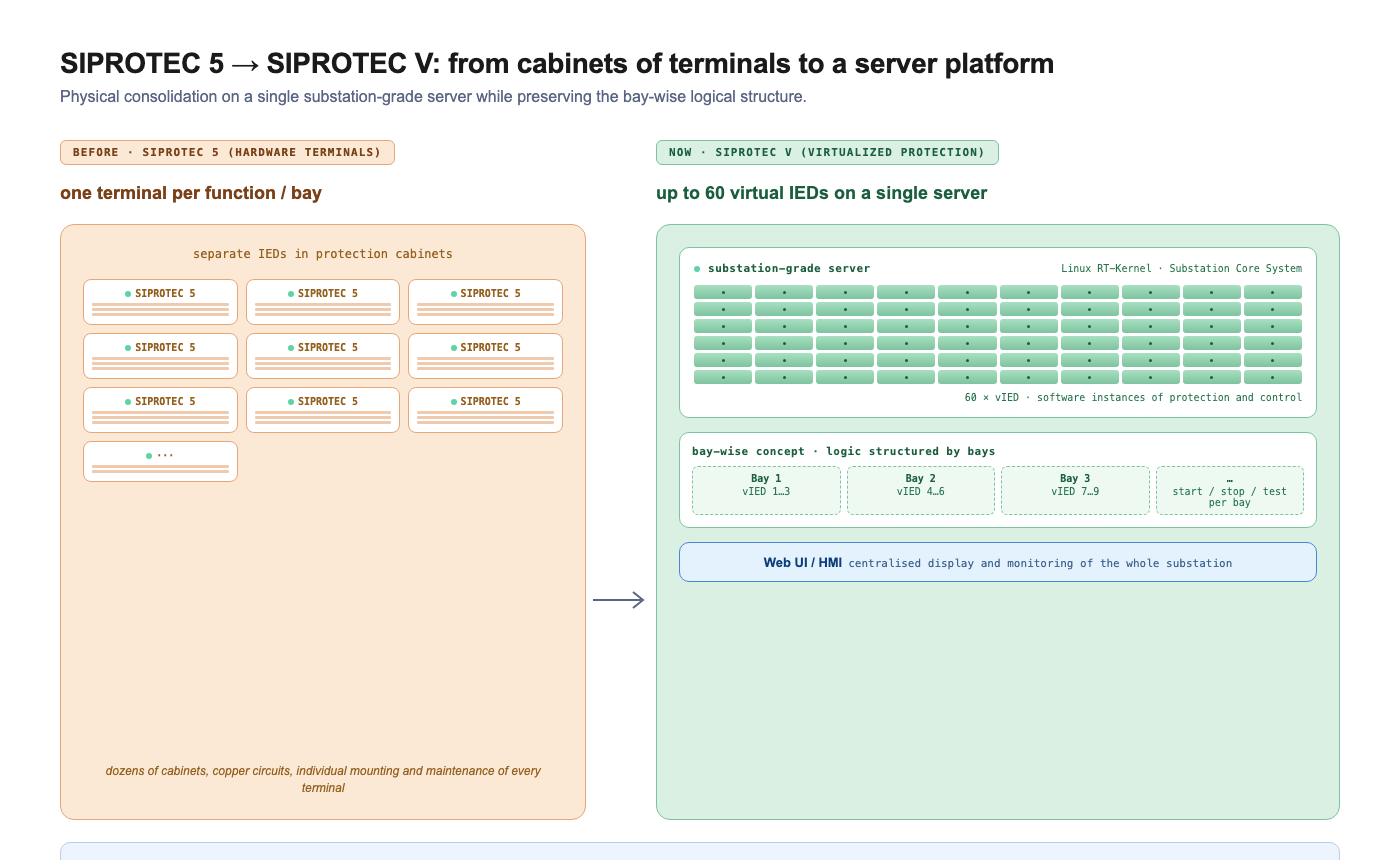
SIPROTEC V is positioned as a solution for centralised substation protection and control. In the product description Siemens states that SIPROTEC V is the virtualized version of SIPROTEC 5 for digital substations.
Architecture: from terminals to a server platform
According to Siemens materials, the SIPROTEC V architecture has several layers:
- Substation-grade computing hardware — a server hardware platform designed for use at an energy facility.
- Linux with a real-time kernel — the operating environment that ensures predictable execution of protection and control tasks.
- Substation Core System and the SIPROTEC 5 protection software — the software environment in which the protection and control functions run.
- Web UI / HMI — the interface for centralised display, control and diagnostics.
- Engineering via DIGSI 5 and the IEC 61850 System Configurator — the engineering toolkit familiar from SIPROTEC 5.
On the product page Siemens separately notes that lifecycle operations can be performed for a single bay without disrupting the operation of the others.
This is an important operational point. Virtualization here should not be read as "everything has been put into one server and now everything depends on one common program". The right picture is a server platform on which separate software instances of protection and control are placed, matching the bay-wise logic.
IEC 61850, GOOSE, MMS and Sampled Values
Technically SIPROTEC V is built specifically for the digital substation architecture. In the product profile Siemens indicates support for:
- IEC 61850 GOOSE;
- MMS server;
- IEC 61850-9-2LE Sampled Values;
- IEC 61869-9 Sampled Values.
The network redundancy mechanisms PRP and HSR are also listed, together with time synchronisation via IEEE 1588 / PTP with support for the profiles used in the power industry.
In practice this points to the target architecture with a process bus, where measurements come from merging units (stand-alone merging units, SAMU), while the server platform performs the protection, control, recording and diagnostics functions.
In such an architecture the role of the following components becomes particularly important:
- correct SCD configuration;
- reliable Sampled Values delivery;
- PTP time synchronisation;
- PRP/HSR network redundancy;
- diagnostics of GOOSE/SV/MMS traffic;
- verification that the actual configuration matches the IEC 61850 project model.
Which protection functions are declared
In the product profile Siemens lists the main classes of protection functions that can be implemented in SIPROTEC V:
- line and feeder protection;
- distance protection;
- overcurrent protection;
- directional overcurrent protection;
- voltage and frequency protection;
- teleprotection / direct trip;
- breaker failure protection;
- automatic reclosing;
- synchrocheck;
- single-ended fault location;
- transformer protection, including differential, overcurrent and thermal overload;
- capacitor bank protection, including current unbalance protection;
- busbar protection for various topologies, including single and double busbar with up to 30 bays.
Of particular interest here is the presence of busbar protection and transformer differential protection in a virtualized server architecture. This is no longer just "simple feeder functions", but a full protection function set for substation applications.
HMI and operation
SIPROTEC V includes an HMI for substation-wide visualisation and control. Siemens states that the integrated HMI provides centralised operation and monitoring of the whole substation.
The operational capabilities include:
- substation-wide visualisation;
- bay-level control and monitoring;
- operation and event logs;
- fault recording;
- measurements;
- diagnostics;
- protection parameterisation;
- backup and restore.
In this respect SIPROTEC V starts to look not only like a "virtual relay", but rather a wider platform for substation operation: protection, control, diagnostics, logs, configuration and software lifecycle are gathered into a single server loop.
Cybersecurity
Siemens places a notable emphasis on cybersecurity. The SIPROTEC V product page lists RBAC, Syslog, CIS-aligned hardening, as well as alignment with the requirements of NERC CIP and BDEW.
For virtualized protection this is a critical block. Whereas previously the attack surface was distributed across many terminals, in a server architecture protecting the operating environment, access control, logging, updates, configuration integrity and certificate management gain weight.
In other words, cybersecurity becomes not an external add-on to the protection system but a part of the protection and control architecture itself.
Why this matters for Siemens and the market
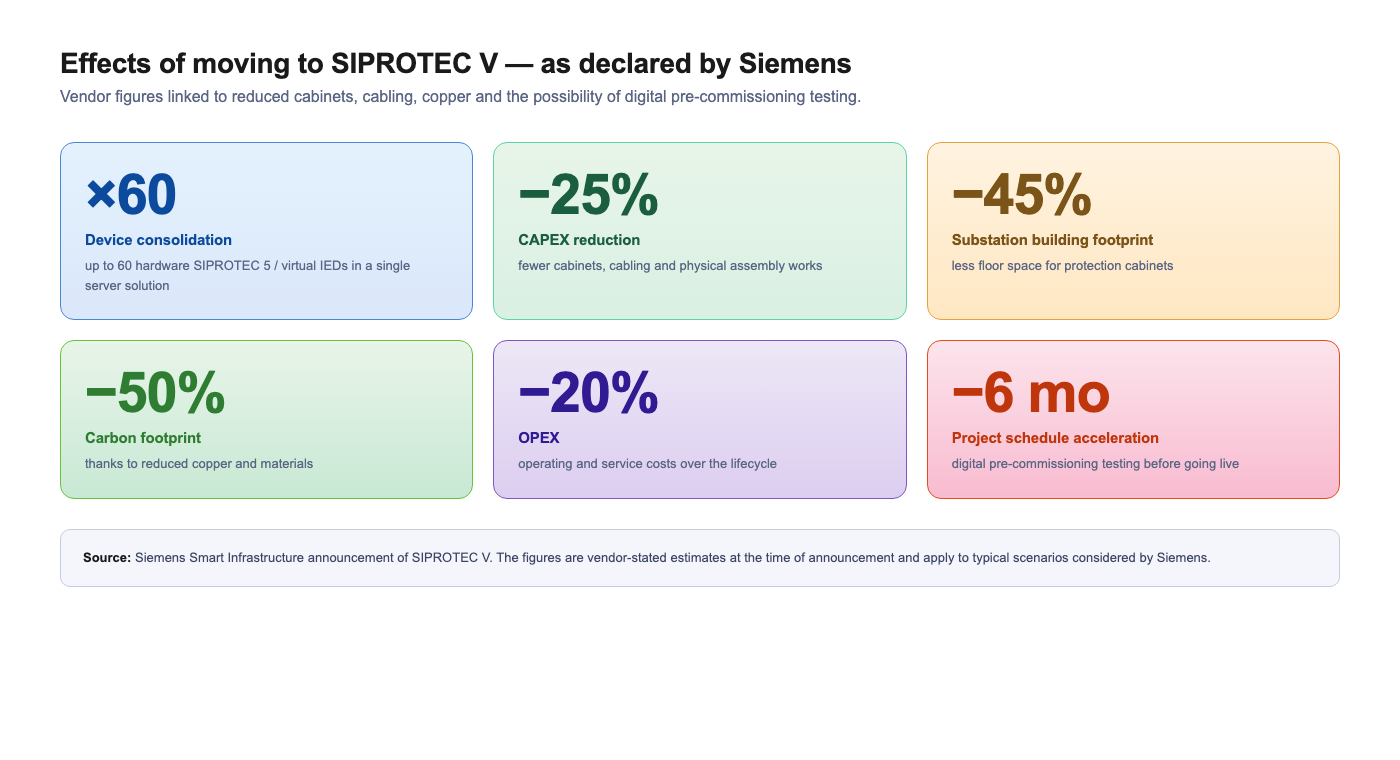
Siemens cites several quantitative effects from the transition to SIPROTEC V:
| Metric | Siemens statement |
|---|---|
| Device consolidation | up to 60 hardware SIPROTEC 5 / virtual IEDs in a single server solution |
| CAPEX reduction | up to 25% |
| Substation building footprint reduction | up to 45% |
| Carbon footprint reduction through less copper and materials | up to 50% |
| OPEX reduction | up to 20% |
| Project schedule acceleration | up to 6 months |
Siemens links these estimates to fewer cabinets, less cabling, fewer physical assembly works and the possibility of digital pre-commissioning testing before going live.
Takeaway
SIPROTEC V is an important marker for the whole digital-substation industry. Virtualized protection is moving from conference talks into the commercial product lines of major vendors.
For protection and SCADA engineers this means that in the coming years they will need to learn and master server architecture, Linux with a real-time kernel, virtual IEDs, the lifecycle of software protection instances, updates, redundancy of the computing platform and cybersecurity as an integral part of the protection system.
SIPROTEC V is not just "a relay on a server". It is an example of the shift from a hardware-centric protection architecture to a software-defined architecture of protection and control of a digital substation.