Релейная защита, АСУ ТП, учёт электроэнергии и кибербезопасность электроэнергетических объектов
The full truth about optical transformers: part 2
2017-08-30T16:54:00+03:00
To dispel all myths surrounding fiber-optic measuring instruments, DGS together with Profotech have prepared material providing answers to the most frequently asked questions. We present its second part, dedicated to the technical operational features of these instruments.
Question 1: What is the service life of a fiber-optic current sensor? Is optical fiber subject to aging?
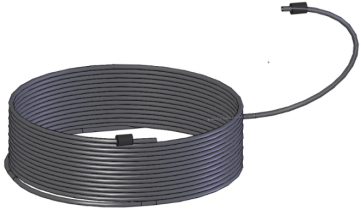
Sensitive fiber element of the OFCT (Optical Fiber Current Transformer): non-removable loop/ "Profotech"
There are no fundamental physical reasons for fiber aging. Aging may occur as a result of technological failures in protecting the fiber from environmental impacts (specifically, due to water penetration into the optical cable structure) and violations of operating conditions (for example, from unacceptable mechanical stresses on the fiber). An indicator of aging can be considered the degradation of fiber parameters, such as an increase in optical radiation losses within the fiber (attenuation/clouding). To exclude the influence of such losses on measurement accuracy and stability, the optical interferometer method described in the previous article is applied, which ensures low dependence on the magnitude of optical attenuation within the fiber.
Problems regarding mechanical fiber breakage are eliminated using a unique "zero-tension" fiber laying technology. This technology was developed by "Profotech" during the refinement of optical transformer designs and is a trade secret.
The impact of moisture on the optical properties of the fiber is currently a long-resolved problem, as the use of modern types of polymer coatings (cable sheaths) and various types of hydrophobic fillers for fiber-optic structure elements allows optical cables to be laid even under seas and oceans at great depths—and in this case, the service life will be measured in decades.
Cables do not contain metallic or other conductive elements and possess enhanced dielectric characteristics.
Sensitive fiber element of the OFCT: removable (flexible) loop/ "Profotech"
For the long-term operation of optical transformers and monitoring the condition of the fiber optic current sensor, the built-in online diagnostic system is of great importance. Diagnostic monitoring consists of continuous (at the process rate) measurement of approximately 20 status parameters of the electro-optical current transformer (EOC-CT) in real time, comparing the obtained values with the maximum permissible limits, and outputting data on the condition of the device modules into sampled values quality metrics according to IEC 61850-9-2, as well as every second to the display of the electro-optical unit and to the LED indicators on the device panel, with the capability of transmitting data for monitoring by external diagnostic systems. Online monitoring of the transformer's operability is provided by a special diagnostic port, which can operate in remote diagnostic mode, or by forming a general operability status according to the IEC 61850-8-1 standard.
Question 2: Are there any limitations on the distance between the electronics unit, installed at the common control station (CCS), and the sensitive optical element, installed in the outdoor switchgear (OSG)?
For a fiber optic current transformer, there is a certain limitation on this distance—its maximum is 1300m.
The existence of this limitation is explained by the operating characteristics of the fiber optic modulator, one of the main elements of the current transformer. The modulator operates on the principle of delayed phase modulation of the phase shift between the operating light waves of an optical interferometer. The practical implementation of this principle requires certain ratios between the operating frequency and the length of the connecting line.
The modulator of the fiber optic current transformer itself is located within the electronics unit. Such placement of the element ensures practically ideal electrical insulation from high voltage and fulfills one of the important requirements for measuring transformers—ensuring maximum safety for maintenance personnel. There is no steel core or shielding, and the fiber optic connecting cable is an excellent dielectric. The mechanical strength of the cable is provided by glass-reinforced plastic rods.
For the electronic voltage transformer, there are no fundamental restrictions on the distance between the electronics unit and the insulation column. However, in practice, 1300m is usually sufficient.
Question 3: Are the sensors with a digital interface complying with the IEC (International Electrotechnical Commission) 61850-9-2LE standard produced by "Profrotech" included in the State Register of Measuring Instruments? What accuracy classes do they have?
Fiber-optic current transformers with a digital interface are included in the State Register of Measuring Instruments as measuring transformers according to GOST (State Standard) IEC 60044-8/7. Their registration data is as follows:
Type approval certificate for measuring instruments RU.C.34541.A No. 62214.
Certificate validity: until 12.05.2021.
Official name according to the certificate: "Electronic optical current transformers (EOC) with digital output".
Accuracy classes of EOC with digital output entered in the State Register:
alternating current (AC): 0.1; 0.2S; 0.5S; 1.0; 5P; 5TPE;
direct current (DC): ±0.1; ±0.2; ±0.5; ±1.0.
Question 4: What is the calibration interval for electronic current and voltage transformers? Is there equipment available for the calibration of sensors with an interface complying with the IEC 61850-9-2LE standard?
The calibration interval for fiber-optic current and voltage transformers is 8 years. Calibration is performed in accordance with the MP2203-0293-2015 procedure "Electronic optical current transformers (EOC) with digital output. Calibration procedure", approved by FSUE (Federal State Unitary Enterprise) "VNIIM named after D.I. Mendeleev" in November 2015. An analogous document also exists for voltage transformers.
All shipped current and voltage transformers are supplied with a mark of primary calibration.
(To be continued.)
If you have any questions about optical transformers, please ask them in the comments on the website, social media, or Telegram chat; we will certainly find an answer.