NamPower commissioned the Sekelduin substation on 24 September 2025 — a 132/66/33 kV indoor switching station east of Swakopmund, Namibia, and the first on the continent to deploy an IEC 61850 process bus as the primary protection backbone. Main protection operates on IEC 61850-9-2LE sampled values and GOOSE over merging units — trip signals are digital end-to-end. Total project investment was N$394 million (approximately US$22.6 million).
Namibian grid rationale
Namibia imports approximately 62% of its electricity consumption, a dependence that has intensified pressure on domestic transmission infrastructure. Sekelduin feeds the coastal Erongo region, where load growth from mining, industry and tourism continues to increase. The substation is fed from the existing Kuiseb substation roughly 35 kilometres to the south-east via two parallel 132 kV overhead lines, providing N-1 redundancy across the corridor. It is NamPower's direct response to a specific transmission constraint — not a prestige project.
Hybrid architecture: process bus for main protection, hardwired backup
Sekelduin uses a hybrid architecture — and that is an intentional design choice.
The main protection system is built on IEC 61850-9-2LE with a redundant process bus and station bus implemented via merging units and process interface units. Current and voltage samples are digitised at the merging unit and transmitted as Sampled Values (SV) over a fibre-optic LAN. Trip and interlock commands travel as GOOSE messages over the same process bus. There are no copper control cable runs from instrument transformers to protection IEDs (Intelligent Electronic Devices) at the main protection level.
The backup protection system retains hardwired connections to conventional CTs and VTs, with station bus GOOSE for inter-IED communication. The backup tier remains independent of the process bus — it cannot be affected by a merging unit failure or a switch fault.
graph TD
    subgraph PRIMARY_EQUIPMENT["Primary Equipment (132/66/33 kV)"]
        CT["Conventional CT/VT"]
        MU["Merging Units (IEC 61850-9-2LE)"]
    end

    subgraph MAIN_PROTECTION["Main Protection — Process Bus"]
        PB["Redundant Process Bus\n(Fibre-optic LAN)"]
        SV["Sampled Values (SV)\nIEC 61850-9-2LE"]
        GOOSE_M["GOOSE Messages\n(Trip / Interlock)"]
        IED_M["Protection IEDs\n(Main)"]
        MU --> PB
        PB --> SV
        PB --> GOOSE_M
        SV --> IED_M
        GOOSE_M --> IED_M
    end

    subgraph BACKUP_PROTECTION["Backup Protection — Station Bus + Hardwired"]
        SB["Station Bus\n(IEC 61850-8-1)"]
        GOOSE_B["GOOSE Messages\n(Station Bus)"]
        HW["Hardwired CT/VT\nAnalogue Inputs"]
        IED_B["Protection IEDs\n(Backup)"]
        CT --> HW
        HW --> IED_B
        SB --> GOOSE_B
        GOOSE_B --> IED_B
    end

    subgraph SCADA_LAYER["Station Level — SCADA / Gateway"]
        GW["Cyber-Secure SCADA\nGateway"]
        IED_M --> GW
        IED_B --> GW
    end

    CT --> MU
This hybrid approach reduces implementation risk while demonstrating end-to-end process bus capability at the primary protection level. A fully process-bus backup would require either redundant merging units at every bay or a separate process bus network — carrying higher commissioning risk for a first-in-continent deployment.
Indoor station with compact switchgear
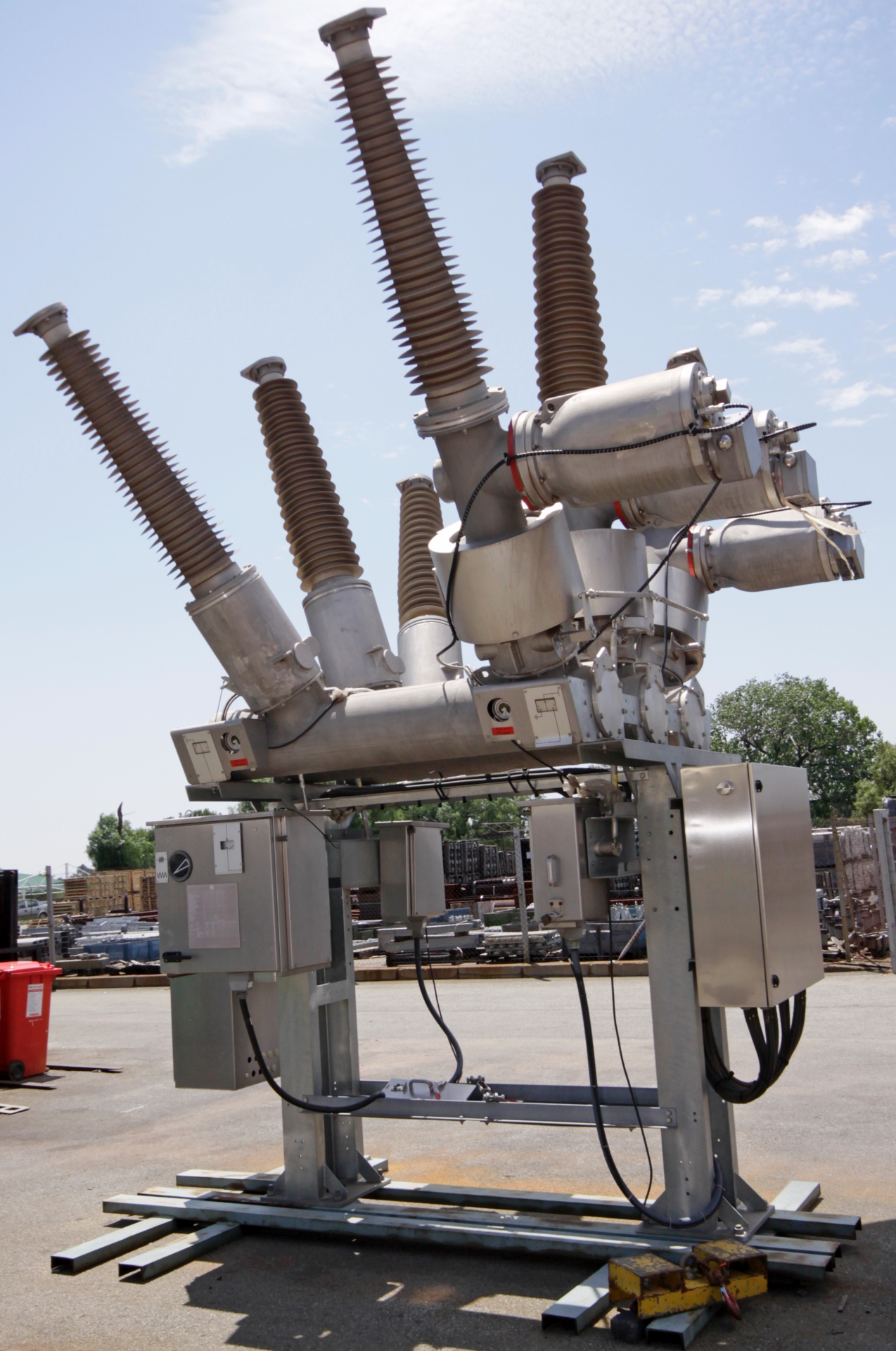
The 132 kV and 66 kV circuits use Compact Mixed Technology Switchgear (MTS) — a hybrid AIS/GIS configuration with gas-insulated breakers and disconnectors in a compact arrangement. The 33 kV tier uses gas-insulated fixed-pattern metal-enclosed switchgear. All equipment is housed indoors.
The primary driver is environmental: the Namibian coastal strip combines marine salt aerosol with desert dust from the Namib, two degradation mechanisms that act simultaneously on outdoor switchgear and insulators. An indoor design eliminates both.
SCADA integration and operational shift
Sekelduin integrates with a cyber-secure SCADA system providing remote control of switching operations and real-time monitoring. Operators at NamPower's control centre can initiate switching without physical presence at a site where field response times would otherwise be measured in hours.
The high-resolution, GPS-synchronised SV streams from the process bus create a data-density environment that supports condition-based maintenance. ACTOM project manager Phuluso Mnisi stated at commissioning that the system allows maintenance to shift from reactive to preventative — a direct operational consequence of continuous, time-stamped asset data. Improved fault location accuracy is a further benefit: synchronised SV frames from each merging unit allow protection IEDs to resolve fault position with a resolution not achievable from conventional analogue inputs.
Copper reduction and physical security
Process bus architecture at the main protection level replaces copper control cable runs — often several kilometres per substation in a conventional design — with fibre-optic links from merging units to the process bus switches. In the African context, this matters beyond installation cost: copper cable theft is a documented operational problem for power utilities across sub-Saharan Africa. Reducing the copper footprint of the secondary systems addresses a physical security risk that is routinely factored into lifecycle cost by African network operators.
First process-bus deployment on the continent
Before Sekelduin, IEC 61850 deployment in Africa had not progressed beyond station-bus implementations and partial automation projects. The process bus — with Sampled Values replacing analogue CT/VT secondaries at the main protection level — had not been delivered end-to-end anywhere on the continent.
NamPower has explicitly positioned Sekelduin as a blueprint for other African utilities. The project demonstrates that the engineering capability, supply chain and commissioning competence required for a fully digital process-bus substation can be assembled and executed within Africa, for African grid conditions. For utilities evaluating their next substation investment, there is now a commissioned, operational reference point. That reference did not exist before 24 September 2025.